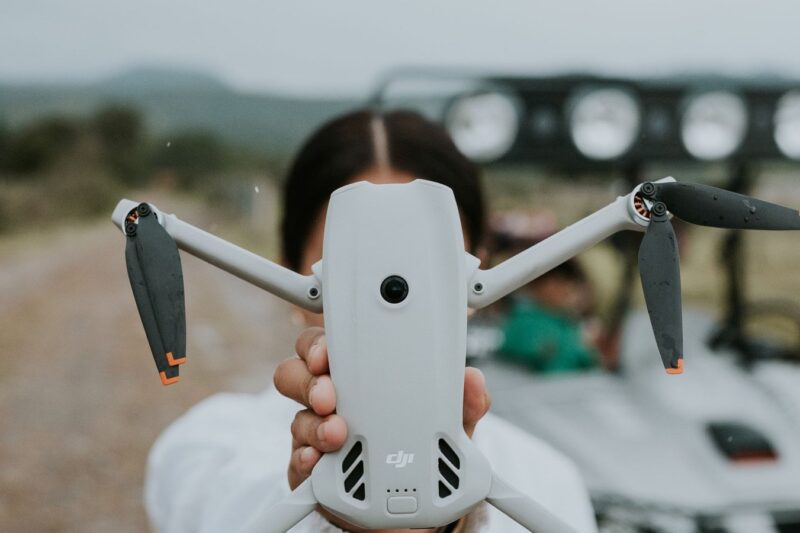
Image: Seth Ebenezer Tetteh / Pexels
This article contains affiliate links, marked (Ad). If you sign up or buy through one, we earn a commission. It doesn’t cost you anything extra and doesn’t change what we include. As an Amazon Associate, Drones Unplugged earns from qualifying purchases. How we make money.
A drone can be a brilliant present for a child: it’s active, it’s outdoors (or at least off the sofa), and it teaches real skills. But the right drone depends a lot on age, and the UK rules for children are different from the rules for adults.
This guide sorts our picks by age and explains the CAA rules in plain English, so you know what to sort out before the box is opened.
Last checked: 19 October 2026, against each maker’s spec pages and the CAA’s registration and children’s guidance. Our picks are research-based, not hands-on, and we haven’t checked UK prices for the sub-100 g models.
Quick answer
For younger children, start with a tiny indoor drone like the Holy Stone HS210. It weighs 24.8 g and has no camera, so the CAA doesn’t require any IDs. For a first camera drone from age 14, the Holy Stone HS130 has a 1080p camera and still stays under the 100 g line. For older teens, the DJI Neo or Neo 2 are proper camera drones, but DJI rates them for ages 16 and up, and they need a Flyer ID and an adult’s Operator ID.
The UK rules for children, in plain English
These come straight from the CAA’s guidance.
Does the drone need any IDs? It depends on weight:
| Drone weight | Flyer ID | Operator ID |
|---|---|---|
| Under 100 g | Not required (the CAA recommends it) | Optional |
| 100 g to under 250 g, with a camera | Required | Required |
| 100 g to under 250 g, no camera | Required | Optional |
| 250 g or more | Required | Required |
Indoors only? The CAA says you don’t need a Flyer ID or Operator ID if you only fly indoors, or somewhere the drone can’t escape, like a closed netted area.
If your child does need IDs:
- Flyer ID. Children need one just like adults. If they’re under 13, the CAA says a parent or guardian must be with them when they take the test.
- Supervision. The CAA says children under 12 must only fly when supervised by someone aged 16 or over.
- Operator ID. You have to be 18 to register. If your child owns a drone that needs an Operator ID, a parent or guardian registers as the operator. The CAA charges £12.34 a year.
Our Flyer ID vs Operator ID guide walks you through setting it up for a family.
Best indoor drone for younger children: Holy Stone HS210
Holy Stone’s spec page lists the HS210 at 24.8 g, with a 9-minute maximum flight time per battery, a 50 m range and propeller guards. It has no camera and no GPS, and Holy Stone recommends indoor practice, pitching it as a way to learn the basics: take-off, landing, hovering, turning and recovery.
The box typically includes three batteries, according to Holy Stone, though contents can vary by seller. The controller runs on 1.5V AAA batteries, which Holy Stone says are not included.
Why it suits kids: it’s light, guarded and simple, so mistakes are cheap and the focus is on learning to fly. Holy Stone also has Altitude Hold, Headless Mode and three speed settings to help beginners. Rules: at 24.8 g with no camera, the CAA doesn’t require a Flyer ID or an Operator ID. Indoors, no IDs are needed at all. Watch out: Holy Stone says it’s designed mainly for indoor flying, and that children under 10 should only fly with close adult supervision. Check UK availability before you buy; we haven’t verified current UK stock or price.
Best first camera drone (14 and up): Holy Stone HS130
The HS130 has a 1080p camera and folds small. The Amazon UK listing gives its weight as 94 g, so it sits under 100 g, and says its two batteries give up to 22 minutes of flying in total.
Why it suits kids: it has a camera and live view, so it feels like a “real” drone, but it stays under the 100 g line. Rules: under 100 g, the CAA doesn’t require a Flyer ID, and the Operator ID is optional, even with the camera. The CAA still recommends taking the free Flyer ID test, which is a good way to teach the Drone Code. Watch out: the Amazon UK listing says it’s not suitable for under-14s, and to use it with supervision. It’s close to 100 g, so weigh it with everything fitted.
What about the Ryze Tello? It’s no longer sold new in the UK: DJI’s UK store lists it as not available, and UK retailers we checked show it as no longer available.
Best for older teens: DJI Neo or DJI Neo 2
Once a child is older, a proper camera drone is a real step up. DJI’s UK FAQ puts the original DJI Neo at about 135 g with fully enclosed propeller guards, and the Neo 2 is 151 g and C0 certified. Both can take off from and land on your palm.
Why they suit teens: they’re small, simple and shoot genuinely good video for social media and days out. Rules: both are over 100 g with a camera, so the pilot needs a Flyer ID and the owner needs an Operator ID. For anyone under 18, that means a parent or guardian registers as the operator. Watch out: DJI says both are suitable for ages 16 and above, so they’re not for younger children. Our DJI Neo 2 UK rules guide covers registration, and if palm takeoff ever plays up, see DJI Neo palm takeoff not working.
For more options at this level, see our best drones under £300 guide.
How to choose a drone for a child
- Start with the age. Check the maker’s age guidance on the box or product page. Many camera drones, including DJI’s, say 16 and up.
- Stay under 100 g for younger children. It keeps the rules simple and the drone less likely to cause damage.
- Think indoors first. A guarded indoor drone is the safest way to learn the controls before going outside.
- Camera or no camera? A camera is fun, but for a first drone it can distract from learning to fly.
- Plan the IDs before the big day. If the drone needs them, sort the Flyer ID test and Operator ID in advance.
Safe flying tips for families
- Read the CAA’s Drone and Model Aircraft Code together. It’s what the Flyer ID test is based on.
- Fly in open spaces away from people, pets, roads and buildings. Our where can I fly my drone in the UK guide explains the restrictions.
- Keep the drone in sight at all times.
- Keep fingers, hair and faces away from spinning propellers, even with guards fitted.
- Charge batteries somewhere you can keep an eye on them.
Frequently asked questions
Does my child need a licence to fly a drone in the UK?
There’s no “licence”, but there are IDs. Under 100 g, the CAA doesn’t require any. At 100 g or more, they need a Flyer ID, and if it has a camera, an adult must hold the Operator ID.
Can a child take the Flyer ID test?
Yes. If they’re under 13, the CAA says a parent or guardian must be with them during the test.
Can my child fly a drone on their own?
If they’re under 12, the CAA says they must be supervised by someone aged 16 or over when they fly.
What’s the best first drone for an 8-year-old?
A tiny, guarded indoor drone with no camera, such as the Holy Stone HS210, flown with close adult supervision.
Can I register the Operator ID for my child?
Yes, and you have to: the CAA says you must be 18 to register, so a parent or guardian registers as the operator.
Keep reading
This guide is general information, not legal advice. The CAA’s website is the official source for UK drone rules, so check it before you fly.
Sources (checked 19 October 2026)
- CAA, Registering to fly drones and model aircraft: requirements by weight and camera, flying indoors. caa.co.uk registering
- CAA, Children and parent guidance: Flyer ID for under-13s, supervision of under-12s, Operator ID age. caa.co.uk children and parent guidance
- CAA, Get an Operator ID: fee. caa.co.uk Operator ID
- Holy Stone HS210 product and spec page: weight, flight time, range, features, box contents, outdoor and supervision guidance. holystone.com HS210
- Amazon UK listing, Holy Stone HS130: weight, camera, batteries and total flight time, minimum age. amazon.co.uk HS130 (Ad)
- DJI Store UK, Tello product page: “Not available in your country/region”. store.dji.com/uk Tello
- DJI Neo FAQ (UK): about 135 g, enclosed propeller guards, palm takeoff, age 16 and above. dji.com/uk/neo/faq
- DJI Neo 2 specs (UK): 151 g. dji.com/uk/neo-2/specs
- DJI Neo 2 FAQ (UK): C0 certified, palm takeoff, age 16 and above. dji.com/uk/neo-2/faq